
Introduction
Efficient bulk material handling is essential in industries such as mining, agriculture, cement, power generation, food processing, pharmaceuticals, and manufacturing. Companies continuously seek innovative methods to improve operational efficiency while reducing equipment wear, energy consumption, and downtime. One of the most powerful engineering tools available today is Discrete Element Modeling (DEM). By simulating the movement and interaction of individual particles, Discrete Element Modeling (DEM) provides engineers with valuable insights that are impossible to obtain through traditional design methods alone.
Advanced simulation technology enables engineers to analyze how materials behave under different operating conditions before physical equipment is built. This predictive capability reduces costly design errors, enhances productivity, and supports data-driven engineering decisions. As industries embrace digital engineering, DEM has become an essential component of modern bulk material handling system design.
Understanding Discrete Element Modeling
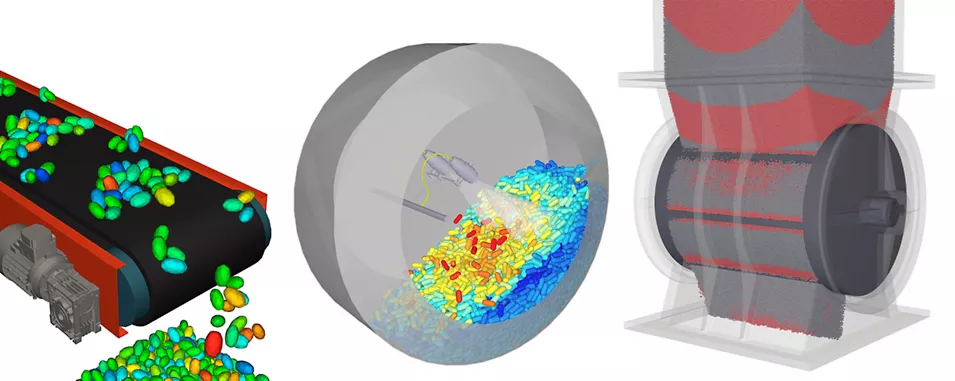
Discrete Element Modeling is a numerical simulation method developed to study the behavior of granular materials. Unlike conventional engineering analysis that treats materials as continuous masses, DEM models every individual particle separately. Each particle interacts with neighboring particles and surrounding equipment based on mathematical contact models.
The simulation calculates variables including:
- Particle velocity
- Collision forces
- Contact pressure
- Energy transfer
- Flow patterns
- Material segregation
- Wear potential
Because every particle is individually tracked, engineers gain a detailed understanding of how bulk materials move through equipment such as conveyors, hoppers, chutes, silos, crushers, feeders, mixers, and transfer points.
This detailed visualization allows engineers to optimize designs before manufacturing begins, saving both time and development costs.
How DEM Simulation Works
The simulation process begins by creating a digital model of the equipment. Engineers then define material properties such as particle size distribution, density, elasticity, friction coefficients, moisture content, and shape characteristics.
The DEM software performs calculations over thousands or even millions of time steps. During each step, it evaluates particle interactions and computes:
- Particle-to-particle collisions
- Particle-to-wall interactions
- Gravitational effects
- Frictional resistance
- Rotational motion
- Impact energy
The result is a highly realistic simulation of material behavior under actual operating conditions.
Modern computing power has significantly expanded the capabilities of Discrete Element Modeling (DEM), allowing engineers to simulate millions of particles with remarkable accuracy.
Applications Across Industries
DEM has become widely adopted across numerous industrial sectors because of its versatility and predictive capabilities.
Mining Industry
Mining operations handle enormous volumes of ore, coal, and aggregates daily. DEM assists engineers in optimizing:
- Crusher performance
- Conveyor transfer systems
- Stockpile management
- Feeder efficiency
- Screening equipment
- Material blending
The simulations reduce blockages, minimize equipment wear, and improve throughput.
Agriculture
Agricultural equipment manufacturers use DEM to improve grain handling systems, seed processing equipment, fertilizer spreaders, and storage silos. Better material flow leads to reduced product damage and increased operational efficiency.
Cement Manufacturing
Cement plants rely heavily on efficient bulk material transport. DEM helps optimize raw meal handling, clinker movement, storage systems, and kiln feeding operations while minimizing maintenance requirements.
Pharmaceutical Production
The pharmaceutical industry requires precise mixing and handling of powders and granules. DEM simulations help optimize blending equipment while maintaining product quality and consistency.
Food Processing
Food manufacturers use DEM to analyze cereal, sugar, coffee beans, rice, flour, and snack products during transportation and packaging to reduce breakage and improve process efficiency.
Benefits of DEM in Bulk Material Handling
Advanced simulation provides several measurable advantages throughout equipment design and plant operation.
Improved Equipment Design
Engineers can identify design weaknesses before fabrication begins. Components such as chutes, hoppers, feeders, and conveyors can be optimized to achieve smoother material flow and greater efficiency.
Reduced Material Blockages
Flow interruptions can significantly impact production. DEM identifies regions where material arching, rat-holing, or bridging may occur, allowing design modifications before installation.
Lower Maintenance Costs
Simulation identifies areas subjected to excessive impact and abrasion. Engineers can redesign equipment geometry or select improved wear-resistant materials, extending equipment life.
Increased Throughput
Optimized material flow allows facilities to process larger volumes with existing infrastructure while minimizing bottlenecks.
Enhanced Safety
Unexpected material buildup and uncontrolled flow can create hazardous conditions. DEM helps identify these risks during the design stage, improving plant safety.
Reduced Energy Consumption
Optimized equipment geometry decreases friction losses and unnecessary material impacts, leading to lower power requirements across the material handling system.
DEM and Equipment Wear Analysis
Equipment wear represents one of the largest maintenance expenses in bulk material handling operations. Every particle collision contributes to gradual surface degradation.
DEM provides engineers with detailed wear predictions by analyzing:
- Impact frequency
- Collision velocity
- Contact pressure
- Sliding distance
- Abrasive interactions
These predictions enable engineers to reinforce high-wear regions, redesign transfer points, or modify material trajectories to extend equipment service life significantly.
Integration with Other Engineering Tools
Modern engineering projects increasingly integrate DEM with complementary simulation technologies.
For example, DEM can work alongside:
- Finite Element Analysis (FEA)
- Computational Fluid Dynamics (CFD)
- Structural analysis software
- Process simulation tools
- CAD modeling platforms
This integrated engineering approach enables complete digital evaluation of mechanical performance, structural integrity, airflow, thermal effects, and material movement within a single project workflow.
Challenges of DEM Simulation
Although DEM offers significant advantages, successful implementation requires careful attention to several factors.
Accurate material characterization is critical. Incorrect particle properties may produce misleading simulation results.
Computational requirements can also be substantial. Large industrial models involving millions of particles require high-performance computing resources and extended simulation times.
Additionally, model calibration using experimental data is often necessary to ensure simulation accuracy under real operating conditions.
Despite these challenges, ongoing advancements in computing hardware and simulation algorithms continue to improve DEM efficiency and accessibility.
Future Trends in DEM Technology
The future of DEM is closely connected to digital transformation and Industry 4.0 initiatives.
Emerging developments include:
- Artificial intelligence-assisted simulation optimization
- Cloud-based DEM computing
- Digital twin integration
- Real-time operational monitoring
- Automated design optimization
- Machine learning for material calibration
These innovations will allow engineers to perform increasingly complex simulations while reducing computational costs and engineering time.
As industrial facilities become more connected, DEM will play an even larger role in predictive maintenance, process optimization, and intelligent plant design.
Conclusion
Modern industries demand greater efficiency, lower operating costs, and improved equipment reliability. Discrete Element Modeling (DEM) has become one of the most valuable engineering tools for achieving these objectives by accurately simulating the behavior of bulk materials under real operating conditions.
From improving equipment design and increasing throughput to minimizing wear, reducing maintenance costs, and enhancing operational safety, DEM delivers measurable benefits throughout the entire engineering lifecycle. As computing technology continues to evolve, Discrete Element Modeling (DEM) will become even more powerful, enabling engineers to develop smarter, more reliable, and highly optimized bulk material handling systems that meet the growing demands of today’s industrial environment.